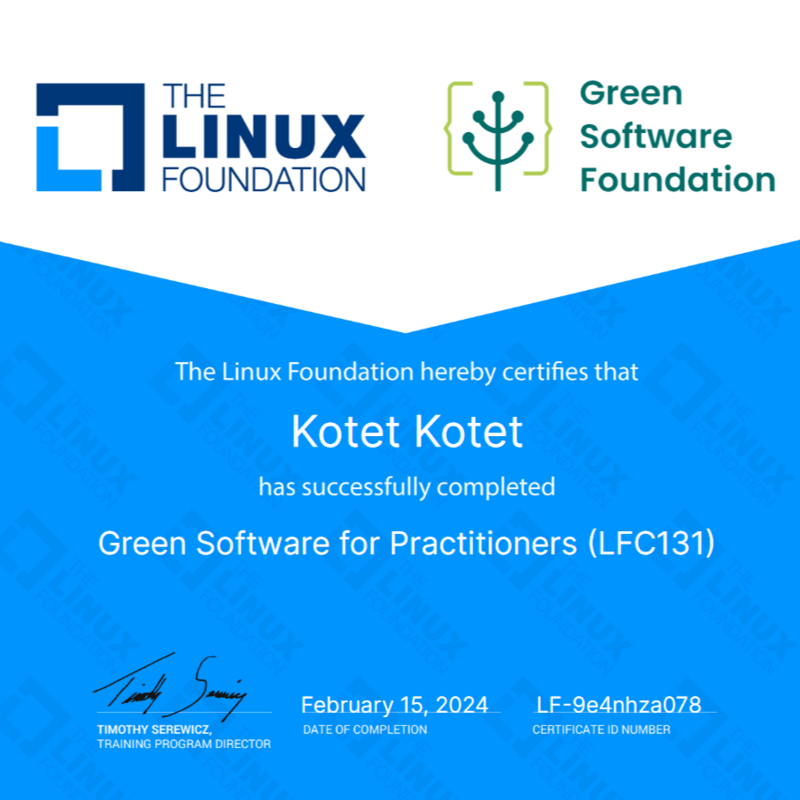
The Linux Foundation offers a course on Green Software. Since it’s free to enroll, I actually took the course and earned the certification.
(Click to link to the original PDF)
In this article, I’ll introduce the content of the course I took and share my impressions after completing the program.
Course Completed
Green Software Training for Practitioners | Linux Foundation
While the entry page is available in Japanese, the content itself is in English. Some images contain text elements, but for the most part it’s text-based content, so machine translation should work fine for completing the course.
**
Course Content
Each chapter includes an assessment test.
Chapter 1. Course Introduction
Introduction section covering what Green Software is, why it’s important, and basic terminology. There are numerous three-letter acronyms throughout.
Chapter 2. Carbon Efficiency
Explanation of greenhouse gases and why reducing their emissions is necessary.
Chapter 3. Energy Efficiency
Describes energy efficiency as Green Software’s first priority. Includes discussions on PUE (Power Usage Effectiveness) - a metric for data center energy efficiency, and Energy proportionality (a concept noting that server power consumption doesn’t follow simple linear relationship with load - the terminology seems somewhat misleading, doesn’t it?).
Chapter 4. Carbon Awareness
Explanation of the Carbon Awareness framework. Focuses on shifting energy demand to reduce environmental impact by being mindful of how electricity’s carbon intensity varies by time and location.
Understanding power grid operations is crucial for implementing this approach. Key concepts include Marginal carbon intensity (the additional carbon emissions resulting from each additional unit of demand).
Chapter 5. Hardware Efficiency
Examines embodied carbon emissions (carbon emissions from manufacturing and disposal). Finds that greenhouse gas emissions from hardware production actually exceed those generated by the hardware itself during operation. Therefore, reducing the number of servers and increasing utilization per server is fundamentally important. For this reason, using public cloud services that share resources with other users is recommended.
Chapter 6. Measurement
Explanation of methods for measuring corporate greenhouse gas emissions. Covers the GHG Protocol measurement framework. Also introduces Software Carbon Intensity (SCI) as an indicator for measuring the carbon intensity of software.
When a company claims to use 100% renewable energy, this typically means purchasing REC certificates. These certificates verify that an equivalent amount of electricity was generated from renewable energy sources to match the company’s consumption. However, this method has significant limitations, and the chapter also discusses the concept of 24/7 hourly matching as a potential solution to address these issues.
Chapter 7. Climate Commitment
Describes methods for corporate greenhouse gas reduction strategies. While mentioning carbon trading, the text emphasizes the fundamental necessity of actual emission reductions. To achieve carbon neutrality, the worst-case scenario requires only measuring emissions and purchasing equivalent carbon credits. However, sufficient carbon credits do not exist for every company to implement this approach. The chapter also clarifies the definitions of terms like “carbon neutral” and “net zero.”
Final Exam
The final examination. Contains 20 questions in total, with a passing score of 80% or higher.
Post-Course Reflections
Overall, the course comprehensively covers most considerations that naturally come to mind when seriously aiming to reduce greenhouse gas emissions. As indicated by its “for Practitioners” title, the content provides essential knowledge for corporate personnel who need to demonstrate their company’s environmentally responsible practices. Being a serious course, it doesn’t offer any quick-fix, genius-level solutions.
For the final exam, a passing score requires answering 16 or more out of 20 questions correctly. I scored 17 correct answers. While some questions had somewhat ambiguous English phrasing, none required exceptionally high-level reasoning, so it’s not particularly difficult. Furthermore, even if you fail, you can retake the exam as many times as needed. Some companies apparently offer incentives for employees to complete and pass this course, and there are even references to this potential application scenario in the content.
The course itself can be completed in about 2 hours, with specific detailed topics linked for further exploration. In particular, I obtained several useful links to resources about carbon-aware software development, which I plan to utilize in future projects.
Summary
I completed a course on Green Software. The content provides concise yet comprehensive coverage of essential knowledge for corporate personnel involved in environmental sustainability initiatives. It doesn’t present any completely unexpected or groundbreaking methods. However, it does provide the vocabulary and framework for thinking systematically about greenhouse gas emission reduction.